Introduction
As the maritime industry explores pathways to reduce emissions while maintaining reliable global trade, nuclear propulsion is increasingly being assessed as a potential solution for commercial shipping. Turning that potential into reality will require collaboration across ports, regulators, ship operators and technology developers.
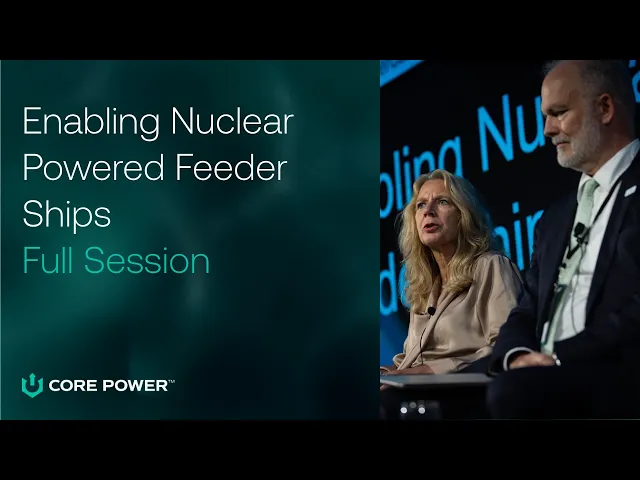
This session from the CORE POWER London Summit 2026 examines the practical considerations involved in enabling nuclear-powered feeder ships, building on findings from the joint Port of Rotterdam case study conducted by CORE POWER, Lloyd's Register, the Port of Rotterdam Authority and A.P. Moller – Maersk.
Session Overview
The discussion explores how existing port safety frameworks could accommodate nuclear-powered commercial vessels while identifying the additional work required to support future deployment. Drawing on the findings of the Port of Rotterdam study, panelists examine topics including regulation, governance, emergency preparedness, liability, security and public engagement.
Set against the wider backdrop of maritime decarbonization and growing demand for resilient, reliable energy solutions, the session also considers how nuclear propulsion could complement alternative fuel pathways such as hydrogen, ammonia and e-fuels. Speakers discuss the practical frameworks, international coordination and infrastructure needed to move maritime nuclear from feasibility studies towards commercial deployment.
The conversation highlights the importance of cross-sector collaboration in preparing ports and the wider maritime industry for the next generation of nuclear-powered vessels.
Speakers
Moderator
Tobi Menzies, CORE POWER
Panelists
Renate Westerndorff, Port of Rotterdam Authority
Françoise van den Brink, Port of Rotterdam Authority
Richard Freston, Lloyd's Register
Scott Edwards, CORE POWER
Watch the full session above to hear the discussion in full.


