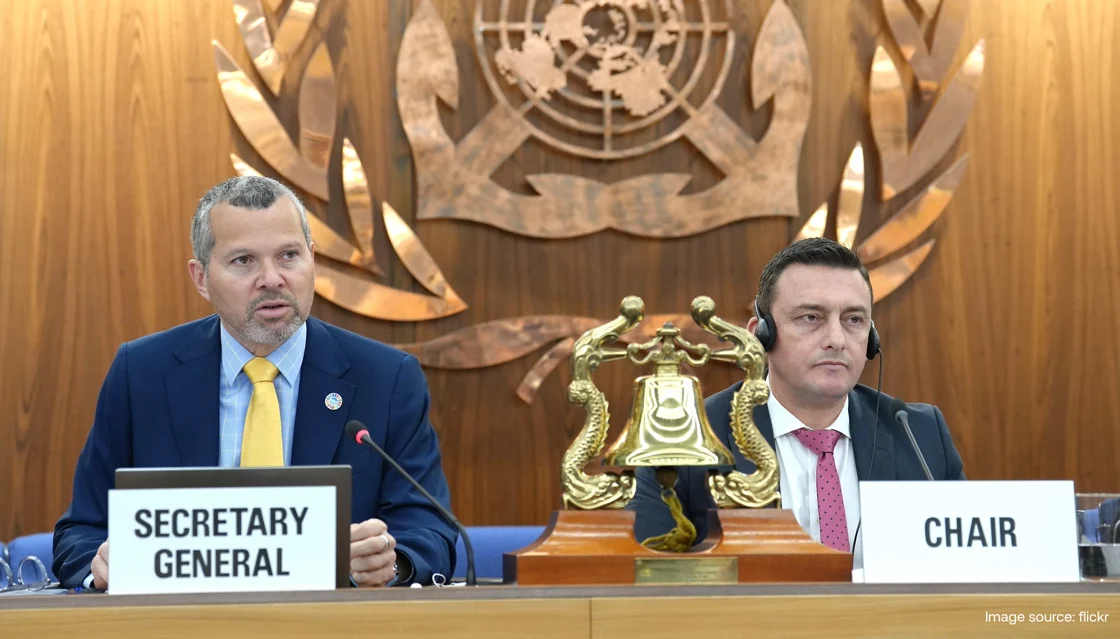
Nuclear-powered ship security, and the possibility of developing International Maritime Organizaton (IMO) guidelines for floating nuclear power plants (FNPPs) were on the agenda during the 111th session of the IMO’s Maritime Safety Committee (MSC 111) when it met from 13 to 22 May, 2026.
The discussion about nuclear ship security was raised in a paper submitted by Chile regarding the work underway at the Sub-Committee on Ship Design and Construction (SDC) to revise the Code of Safety for Nuclear Merchant Ships (resolution A.491(XII)).
Chile’s paper pointed to a variety of security considerations for nuclear-powered ships, such as sabotage or other forms of intentional interference, as well as external threats and risks, such as hijacking, piracy, terrorism and cyberattacks. Chile therefore suggested that MSC should clarify to clarify the scope of the Nuclear Code “so that it also addresses the security dimension, in addition to the safety issues already covered”.
The discussion that ensued showed mixed views, with several countries supporting Chile’s suggestion to expressly include and elaborate on security within the Nuclear Code. Other countries, meanwhile, pointed out that security is not within the remit of SDC, so it would need to be dealt with by other IMO committees. Others suggested that MSC should allow the SDC correspondence group currently working on the Nuclear Code revision to continue its work on preparing an inventory of topics that should dealt with be in the revised Nuclear Code, before making a decision.
The Nuclear Energy Maritime Organization (NEMO) advised MSC 111 that the Nuclear Code is first and foremost a safety standard, and suggested to address security in a similar manner as in the existing Nuclear Code, which calls for security to be taken into account in the nuclear ship’s design and operation, while ensuring that security features do not compromise the safety of the crew or ship safety functions.
Several countries, and NEMO, also pointed out that ship security is addressed in other IMO instruments, in particular the International Ship and Port Facility Security (ISPS) Code, and that nuclear security and safeguards is the remit of the International Atomic Energy Agency (IAEA). The way ahead, therefore, could be for the Nuclear Code to insert references to appropriate IMO and IAEA security standards.
Given the diverging views, it was agreed to invite the SDC correspondence group to continue its deliberations on which topics should be included in the Nuclear Code, taking the discussion at MSC 111 into account. The meeting also agreed that interested parties can submit proposals on how to address security for nuclear ships to a future session of MSC.
IMO guidelines for FNPPs deemed premature
Russia submitted a paper to MSC 111 calling for the IMO to develop non-mandatory safety guidelines for non-self-propelled floating power units with nuclear reactors, commonly referred to as FNPPs. This was the second time Russia presented a proposal for the IMO to provide a regulatory framework for FNPPs. The first version, submitted to MSC 110, proposed that FNPPs should be explicitly included in the revision of the Nuclear Code. That proposal was rejected by a large majority.
This time around, the mood was different. Of the 20 countries that spoke, eight were in favor of the IMO starting work on a non-mandatory instrument for FNPPs, and for SDC to work on this in parallel with the update of the Nuclear Code. The remaining 12 countries were opposed the Russian proposal, many suggesting FNPP standards should be led by the IAEA, and said IMO work on FNPPs was premature at this stage. Many pointed to the work already underway at the IAEA on developing standards for FNPPs, saying this should be allowed to mature further prior to IMO taking on new work in this area. Some also pointed to the potential for creating confusion if SDC was to deal with FNPPs and the update of the Nuclear Code -which addresses nuclear-powered ships - in parallel.
The emerging consensus was that the IMO will need to do work on this at some stage to address the maritime safety aspects of FNPPs, which the IAEA will not address in their nuclear safety standards. It is a question of timing, however, and the majority view did not support starting this work at the IMO yet.
In the meantime, MSC agreed to instruct the IMO Secretariat to liaise with the IAEA and follow the IAEA’s work on this issue, and report back to MSC on progress so MSC can decide in the future on the appropriate time for IMO to start work on the maritime safety aspects of FNPPs.


