
Recent discussions at both the IAEA Technical Meeting on Deployment Models for Transportable Nuclear Power Plants (TNPPs) and the Louisiana Nuclear Strategy and Supply Chain Summit highlighted increasing focus on the practical frameworks needed to support advanced nuclear deployment, from regulation and licensing to industrial capability and infrastructure readiness.
Held under the IAEA’s International Project on Innovative Nuclear Reactors and Fuel Cycles (INPRO), the Technical Meeting on Deployment Models for TNPPs brought together regulators, reactor developers, NGOs and international organisations to examine deployment models for transportable and floating nuclear power plants (TNPPs and FNPPs). Licensing, transport logistics, safety, security and cross-border operations were all central themes throughout the four-day meeting.
CORE POWER’s Vice President for Regulatory Development, Scott Edwards, contributed to the Licensing and Regulatory Panel alongside representatives from the IAEA and the US Nuclear Regulatory Commission (NRC). Discussions covered the upcoming IAEA ATLAS programme, international deployment models and the practical challenges associated with transporting nuclear systems across national boundaries. A recurring theme throughout the meeting was the need for greater international coordination as deployment strategies continue to evolve, particularly around legal frameworks, transport responsibilities and operational definitions across the TNPP and FNPP sector.
Alongside these regulatory discussions, the Louisiana Nuclear Strategy and Supply Chain Summit reflected growing interest in the role advanced nuclear could play in supporting future power demand, industrial competitiveness and long-term energy resilience in the US. CORE POWER representatives Andrew Crowe and Alice Caponiti engaged with stakeholders across the energy, maritime, regulatory, infrastructure and nuclear sectors, with discussions focused on the conditions required to enable scalable deployment of next-generation nuclear capability.
Conversations throughout the summit highlighted the importance of regulatory clarity, industrial capability, workforce readiness and port infrastructure in supporting future deployment. Discussions around supply chains and nuclear-grade shipyard capability also reflected the increasing attention being placed on delivery and industrial readiness, not just reactor technology itself.
Taken together, both events reflected a broader shift across the sector. Attention is increasingly turning toward the regulatory, industrial and logistical foundations required to support large-scale deployment of advanced nuclear systems, as countries, regulators and industry continue working through the practical realities of implementation.
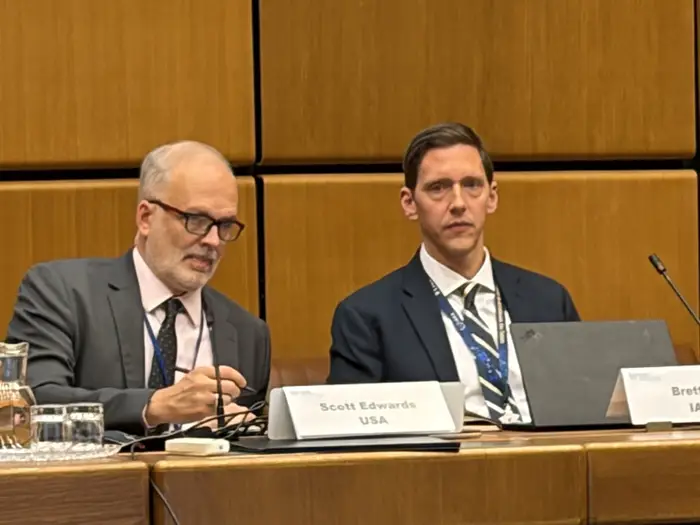
Scott Edwards at the IAEA Technical Meeting on Deployment Models for Transportable Nuclear Power Plants